The University of Adelaide, Australia
Videos
Loading the player ...
- Offer Profile
- Adelaide Robotics Research Group
The Adelaide Robotics Research Group was formed in 2002 to further research into robotics at the University of Adelaide. Areas which are of particular interest to the group include micro-motion manipulators, robotic measurement systems, mobile robotics and the modelling of insects through robotics.
Product Portfolio
Search and rescue UAV
- This honours project involves the design and construction of an autonomous Unmanned Aerial Vehicle (UAV). The aircraft has been designed for civil applications such as surveillance or search and rescue missions by incorporating imaging equipment and payload deployment capabilities.
The multipurpose platform has been configured to take part in the Australian Research Centre for Aerospace Automation’s UAV Outback Challenge to be held in Queensland in September, 2007. For successful entry into this challenge, the UAV must demonstrate the ability to locate and assist a human lost in the Australian outback. A broad study of similar UAVs indicated a conventional design was most suitable for the platform.
The aircraft is manufactured primarily from composite materials using a female mould process. The wings, spanning two metres have a foam core with carbon fibre spars. An electric power plant delivering 4 kilograms of static thrust powers the aircraft with a predicted maximum speed of 120km/hr and an endurance of one hour. The control system incorporates a Micropilot 2028 autopilot enabling autonomous flight and remote communication over a range of 10 kilometres. An analogue camera, mounted in the rear of the aircraft will stream images over a 10 kilometre range with 450 TV lines and a 70 degree field of view.
Testing has been conducted for a parachute recovery system and a descent rate of 5.5 m/s is expected. When launched from a car the aircraft will also be capable of deploying a 600 gram payload.(Maziar Arjomandi, Nayan Uday Avalakki, Jonathan Bannister, Benjamin John J. Chartier, Travis Mark Downie, Brad Alexander A. Gibson, Crystal Rhiannon Gottwald, Peter Ian Moncrieff and Michael Scott Williams)
-
-
-
Wing Borne HydroFoil (WBHF)
- Wingborne水翼(WBHF)是一种高火蚁超人ce marine craft, conceptualised and developed theoretically by Mr. Stephen Bourn. In 2007 undergraduate students commenced a project with the aim to design and manufacture a fullscale functional prototype of a 'Wing-Borne Hydrofoil'. The basis of this design differs from the majority of high-speed sailing craft in that it utilises a wing rather than a conventional sail. The ability of the wing to adjust to the optimal angle relative to the wind gives the WBHF the capability to tack (and hence sail) both upwind and downwind. Furthermore by tacking the craft downwind the craft is able to sail faster than the wind. Another distinguishing feature of the WBHF is its ability to lift the hull out of the water when the craft achieves sufficient velocity, thus eliminating a significant source of drag, and hence accelerating the craft to considerably high speeds. Other design features that contribute to the high performance and safety of the craft include the ability to self-correct and stabilise when the craft becomes unbalanced, the quick release of the wing, customized hydrofoil design suited exclusively to this application and lightweight design of the craft, attained using non-conventional materials and manufacturing methods. The craft employs several control systems to ensure stability once flight is achieved and also provide pilot control. Given these unique characteristics, it is believed the WBHF has the potential to challenge several sailing records including the bi-directional nautical mile sailing speed record and ultimately the world sailing speed record.
(Ben S. Cazzolato, Carl Q. Howard, Danya J. Cheng, Keith Robert R. Crouch, Thomas James Hill, Joshua Johannes Holmes, Ashok Athreya Kaniyal, Antoni Alexander Kourakis, Heath Andrew Nankivell, Benjamin Andrew Ford Newbery, Luke Joseph Rogers and Zhi Qiu Xia)
-
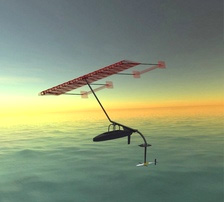
Wing Borne HydroFoil (WBHF)
-
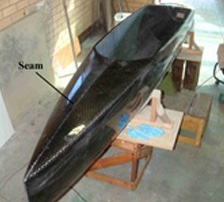
Hull sections joined
- Two carbon fibre halves being joined.
-
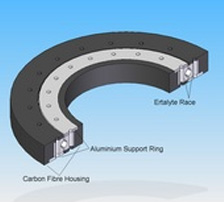
Bearing section view
- Bearings used in coupling main beam to hull and outrigger float.
-
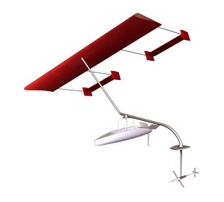
Whole Craft
-
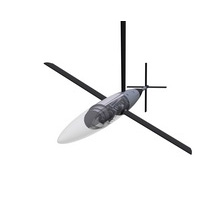
Bulb clear
- Assembly view of the hydrofoil bulb with transparent mid-section and nose cone.
-
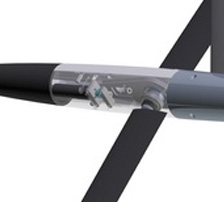
Bulb cutaway
- Cut-away view of the hydrofoil bulb mid-section.
Pneumatic Hand
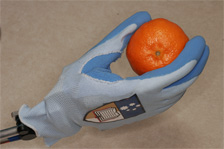
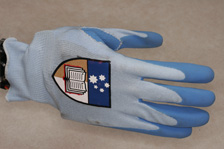
- The School of Mechanical Engineering has been developing air-muscles since 2004. These have been used in a number of honours projects such as Stumpy: A Pneumatic Muscle Actuated Bi-pedal Robot. This project aims to build a fully functional pneumatic prosthetic that is low weight and has fast response times.
(George Osborne)
-
-
Design of an autonomous mobile robot for experiments on multi-agent systems
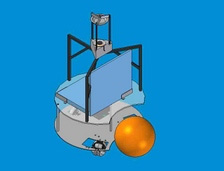
- The aim of this honours project is the design and construction of a fully autonomous mobile robot as a flexible platform for research in the area of robotic multi-agent systems and artificial intelligence. The robot will be designed in conformity with the regulations for the MiddleSize League (MSL, F-2000) of the international robotic soccer competition "RoboCup". Using RoboCup as test-bed, the project aims at developing new control strategies for collaborating multi-agent systems of autonomous mobile robots in a complex and dynamic environment. It is planned to build a competitive team which could enter the 9th RoboCup world championships in 2005.
This project has been launched in 2004. Students from Mechatronics, Mechanical Engineering, Computer Science and Electrical and Electronics Engineering have since been working as part of a faculty wide team.(Frank Wornle)
-
Development of a Stereo Vision and Multiple Laser Stripes based Robotics Measuring System for 3D large surface Profile Acquisition
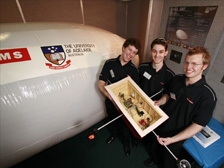
- The aim of this research project is to develop a Robotic Measuring System (RMS) which is used for large surface 3D data acquisition. Normally acquiring three-dimensional surface data can be achieved with precision by use of touch probes. However, computer vision and image processing is faster, especially for extracting a large amount of 3D data such as free-form surface features. The RMS integrates an industrial robot, a set of CCD camera, a laser stripe projector, and a personal computer with appropriate software to perform a large surface measuring task. Topics such as robot calibration, camera calibration, and measurement strategies are to be investigated.
(Jingsyan Torng)
Soccer Server - Artificial Intelligence (AI) for soccer playing mobile robots
-
-
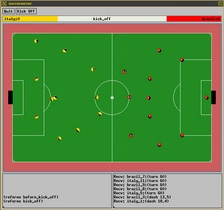
- Every year since 1997, researchers from different countries have gathered to compete in the world championships of robotic soccer. The event has drawn a substantial amount of interest from both industry as well as the general public. The latest RoboCup world championship tournament took place in July 2004 in Lisbon (Portugal) with a total attendance of 224 teams from 34 countries competing for the titles in more than 5 different disciplines. One of these disciplines is the RoboCup Soccer Simulation League also known as 'Soccer Server' League.
Soccer Server is an educational tool for research on multi-agent systems and artificial intelligence (AI). It allows two teams of 11 simulated players (autonomous agents) to play soccer against each other. Matches are carried out on a virtual pitch: The so-called 'soccer server' is a system that simulates the environment, i. e. the pitch itself, the wind conditions, the location and the velocity of the ball, reactions to the player's commands, etc. Each individual player is a client program written in C, C++, Java, etc. Communication between server and clients is built upon the socket based protocol UDP/IP. A match can be visualized using special monitor programs.
足球服务器模拟运动的球和players, communicates with clients, and controls a game according to rules. To control a player, the corresponding client program needs to send requests to the server regarding the actions it wants to perform (e.g. kick the ball, turn, run, etc.). The server receives those messages, handles the requests, and updates the environment accordingly. In addition, the server provides all players with sensory information (e.g. visual data regarding the position of the ball, goals, and other players). It is important to mention that the server is a real-time system working with discrete time intervals (or cycles). Each cycle has a specified duration, and actions that need to be executed in a given cycle, must arrive to the server during the right interval. Therefore, slow performance that results in missing acting opportunities has a major impact on the performance of the team.
的卫冕世界冠军杯赛装病者ion League (2004) is the team ‘STEP’ of the ElectroPult Plant in Russia. Second and third place went to the University of Dortmund (Germany) and Allameh Helli High School (Iran), respectively. Previous winners included the State Key Laboratory of Intelligent Technology and Systems at TsingHua University in China (2001, 2002), the University of Porto (2000), Carnegie Mellon University (1998, 1999) and Humboldt University (1997).(Frank Wornle)
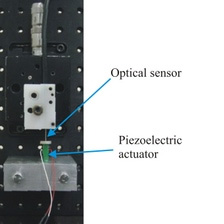
Dynamic modeling, estimation and control of piezoelectric actuator with application in micro-motion system
-